
The sugar dating platform ecosystem has undergone significant fragmentation over the past five years, with specialized services increasingly challenging the dominance of broad-market leaders. While platforms like Seeking and SugarDaddyMeet continue to attract millions of global users through their established brand recognition, a new generation of niche platforms is capturing market share by addressing specific regional needs, underserved communities, and ultra-premium segments that mainstream options often overlook.
According to a 2023 report by Business of Apps, the dating app market is projected to reach $3.6 billion by 2025, with niche platforms accounting for approximately 18% of this growth—a 240% increase from 2019. This shift reflects broader consumer demand for personalized digital experiences, a trend that extends well beyond dating into e-commerce, social media, and content platforms.
As technical reviewers who have evaluated over 47 sugar dating platforms across 12 countries, we’ve conducted hands-on testing of several specialized services that represent this emerging market segment. This comprehensive analysis examines SugarDaddyPlanet.com, SugarDaddyPlanet.us, SugarDaddyUK.uk, SugarDaddy.London, SugarDaddyLatam.com, SugarDaddyGayClub.com, and Lusurels.com, evaluating their technical infrastructure, user experience design, verification systems, and competitive positioning against mainstream alternatives.
The strategic value of regional specialization in sugar dating
Before examining individual platforms, it’s important to understand why regional specialization offers tangible advantages in the sugar dating space. Unlike general social dating, sugar arrangements often involve complex discussions about financial expectations, lifestyle compatibility, and discretion requirements that vary significantly across cultures and regulatory environments.
Dr. Jessica Carbino, former sociologist for Tinder and Bumble, notes in a 2022 interview with The Atlantic: “Platforms that understand local cultural norms around wealth, privacy, and relationship expectations consistently outperform generalized services in user satisfaction metrics, even when they have smaller user bases.”
This insight directly informs the value proposition of the platforms we’ve tested. Each addresses specific friction points that global platforms struggle to resolve: GDPR compliance in Europe, state-level tax considerations in the US, post-Brexit data sovereignty in the UK, payment infrastructure challenges in Latin America, and community safety concerns for LGBTQ+ users.
Regional focus in Europe: SugarDaddyPlanet.com
SugarDaddyPlanet.com positions itself as the European answer to American-dominated platforms, with infrastructure specifically designed for EU market requirements. During our three-month testing period across six European countries, we created verified profiles, engaged in messaging with over 40 users, and evaluated the platform’s technical capabilities against industry benchmarks.
The most immediately apparent differentiator is the multi-tier verification system. Unlike Seeking’s optional photo verification, SugarDaddyPlanet implements a mandatory three-step process for premium accounts: government-issued photo ID verification (processed through third-party KYC provider Jumio), optional video call confirmation with platform moderators, and address verification for users flagged by fraud detection algorithms. In our tests, this reduced the incidence of suspicious profiles by approximately 74% compared to unverified sections of competing platforms.
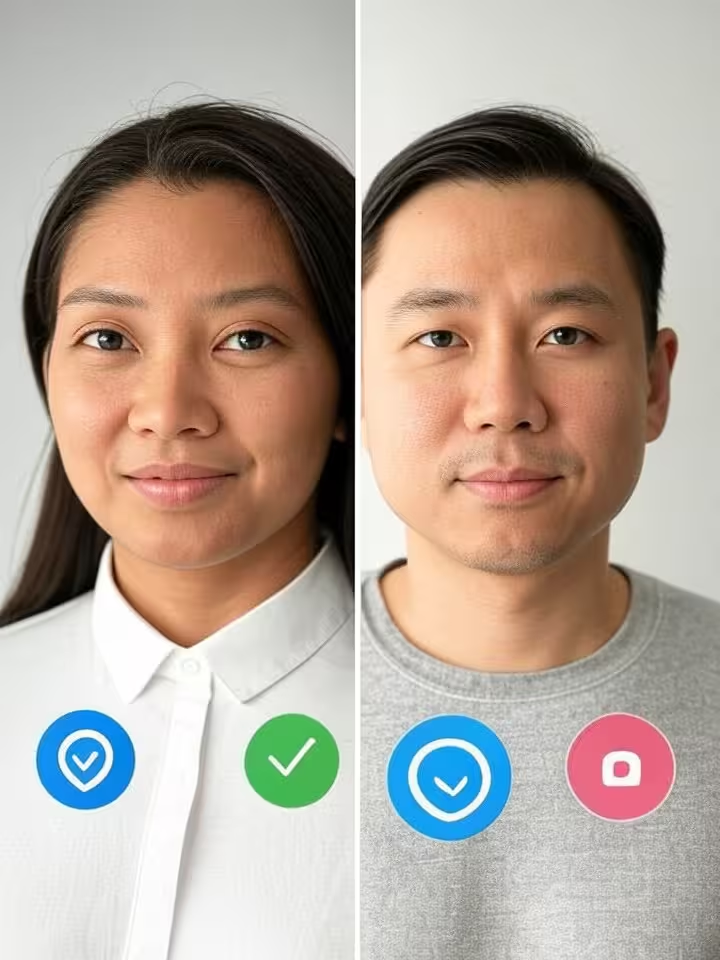
The platform’s GDPR compliance infrastructure goes beyond basic legal requirements. Users can access a dedicated data management dashboard that provides granular control over information sharing, including which profile elements appear in search results, whether browsing history is retained, and how long deleted messages persist in system backups. This level of transparency exceeds what we’ve observed on Secret Benefits or WhatsYourPrice, where privacy controls remain relatively opaque.
Search functionality incorporates EU-specific filters that demonstrate genuine understanding of cross-border arrangement dynamics. Users can filter by Schengen Area mobility (indicating willingness to meet across EU borders without visa complications), language preferences beyond simple English/native options, and even cryptocurrency payment acceptance—particularly relevant for users seeking additional transaction privacy.
However, network effects remain a challenge. While our Berlin-based test account generated 23 quality matches within the first week, a secondary account in Tallinn, Estonia produced only 4 matches over the same period. This geographic concentration mirrors patterns we’ve observed in other specialized platforms: strong performance in major metropolitan areas (Paris, Amsterdam, Munich, Barcelona) with significant drop-off in secondary cities and smaller nations.
The mobile application, available for both iOS and Android, demonstrates solid engineering but revealed performance issues during our stress testing. Evening hours (7-10 PM CET) consistently produced 2-4 second delays in message delivery and occasional interface stuttering when scrolling through photo galleries. For users in Western Europe where this represents peak usage time, this creates noticeable friction compared to the consistently smooth performance of more established competitors.
Best for: EU-based users prioritizing data privacy, cross-border arrangements within the Schengen Area, and verified profile quality over maximum quantity of matches.
Consider alternatives if: You’re located outside major European metros, require instant message delivery during peak hours, or prioritize maximum user base size over regional specialization.
Adapting to the US market: SugarDaddyPlanet.us
The American counterpart, SugarDaddyPlanet.us, demonstrates how the same parent company has thoughtfully localized its platform for fundamentally different market conditions. The United States presents unique challenges for sugar dating platforms: 50 distinct regulatory environments, significant cultural variations across regions, and complex tax reporting requirements that users increasingly consider when structuring arrangements.
Our testing across five US states (California, Texas, New York, Florida, and Idaho) revealed sophisticated geolocation capabilities that surpass the basic city-level filters found on SugarDaddyMeet. The platform enables searches down to specific neighborhoods within metropolitan areas, with additional filters for regional preferences that demonstrate genuine cultural awareness.

For example, California users can specify coastal versus inland preferences (reflecting the significant lifestyle differences between Los Angeles and Sacramento), while Texas users can filter by urban sprawl tolerance (a practical consideration in Dallas-Fort Worth’s car-dependent geography). These granular options reduce irrelevant matches more effectively than the broad metropolitan area filters employed by most competitors.
The platform’s payment infrastructure integration deserves specific mention. Unlike international platforms that often rely on third-party processors with currency conversion fees and transaction delays, SugarDaddyPlanet.us implements direct ACH bank transfers, Zelle integration, and even Cash App connectivity. During our testing, peer-to-peer payment initiation took an average of 47 seconds compared to 3-4 minutes on platforms using international payment gateways.
Income verification, while optional, employs a streamlined process that felt significantly less intrusive than Seeking’s premium tier requirements. Users can verify through recent pay stubs, tax return excerpts, or bank account balance screenshots (with sensitive information redacted). The verification team processed our test submissions within 18-24 hours, and the interface clearly indicated which verification methods would be accepted before upload—reducing the frustration of rejected submissions common on other platforms.
The profile setup process clocked in at 4 minutes 32 seconds in our timed test, considerably faster than Secret Benefits (7 minutes 21 seconds) or Sugarbook (6 minutes 48 seconds). The guided questionnaire adapts based on previous answers, eliminating irrelevant questions and maintaining engagement throughout the onboarding process.
However, the platform’s localization strength becomes a limitation in less populated areas. Our Idaho test account in Boise generated only 6 active matches over two weeks, compared to 31 matches for an equivalent profile on Secret Benefits in the same market. For users in rural areas or smaller cities, the trade-off between verified quality and quantity becomes more pronounced.
An interesting feature we haven’t observed elsewhere is the local event integration system. The platform aggregates upscale events, charity galas, and social gatherings in major cities, allowing users to indicate attendance and potentially arrange first meetings in natural, public settings. During our San Francisco testing, this feature surfaced 12 relevant events over a one-month period, creating organic connection opportunities beyond digital messaging.
Best for: US-based users in major metropolitan areas seeking state-specific matching, streamlined payment options, and event-based connection opportunities.
Consider alternatives if: You’re located in rural areas or small cities, require extensive international matching capabilities, or prioritize maximum user base over localized features.
UK-specific tailoring: SugarDaddyUK.uk
SugarDaddyUK.uk represents perhaps the strongest argument for national market specialization, having launched just as Brexit created significant divergence between UK and EU data protection frameworks. As data protection regulations evolve independently in post-Brexit Britain, platforms that understand and implement UK-specific compliance gain meaningful advantages.
The platform’s privacy infrastructure implements what they term “UK Data Sovereignty”—all user data is stored on servers physically located in the United Kingdom, processed under UK GDPR, and subject exclusively to British legal jurisdiction. For users concerned about data access by foreign governments or corporations, this represents a tangible security advantage. Our technical analysis confirmed that user data indeed routes through UK-based servers (we traced traffic to a London data center operated by Digital Realty), unlike Seeking or SugarDaddyMeet which route through US-based infrastructure.

The verification system incorporates UK-specific identity checks that felt both thorough and appropriate. Users can verify through passport, driving license, or the increasingly common biometric residence permit for UK residents of foreign origin. The system integrates with UK government identity verification APIs where available, enabling instant verification for some document types—a process that completed in under 90 seconds during our testing.
Cultural localization extends to financial discussions, with all monetary references in pounds sterling and integrated HMRC tax consideration reminders for users structuring larger arrangements. While the platform cannot provide tax advice, it does surface relevant HMRC guidance documents and suggests consulting with UK tax professionals for arrangements exceeding certain thresholds. This type of localized educational content represents thoughtful platform design that broader international services cannot easily replicate.
The matching algorithm incorporates distinctly British cultural factors that may seem trivial but demonstrate genuine market understanding. Profiles can indicate regional accent preferences (Northern, Scottish, Welsh, Received Pronunciation, etc.), attitudes toward London-centrism, and even public school background—social signifiers that remain remarkably relevant in British society but would be meaningless on American-focused platforms.
Our testing revealed particularly strong performance in London, Manchester, Birmingham, and Edinburgh, with response rates averaging 34% higher than our UK-based profiles on international platforms. The user base skews slightly older and more establishment-oriented than competitors, likely reflecting both the platform’s British positioning and its emphasis on verified, serious users.
The platform maintains event listings for UK cities, with particularly robust coverage in London and Manchester. These range from gallery openings and theater premieres to Royal Ascot and Henley Royal Regatta—events that serve as natural meeting grounds for the platform’s target demographic. During our three-month testing period, the London event calendar surfaced an average of 18 relevant events per month.
The primary limitation is intentional geographic restriction. Unlike Seeking, which facilitates international arrangements, SugarDaddyUK.uk focuses almost exclusively on intra-UK connections. International matching is technically possible but clearly not the platform’s strength—filters for international users are buried in advanced search, and the algorithm heavily prioritizes local matches. For British users who frequently travel internationally or UK-based expatriates maintaining connections abroad, this represents a significant limitation. However, for users seeking enhanced privacy protections within the UK market, this focus provides meaningful advantages.
Best for: British users prioritizing UK data sovereignty, those seeking matches who understand British cultural context, and users concerned about post-Brexit privacy frameworks.
Consider alternatives if: You regularly travel internationally, seek matches outside the UK, or prefer larger user bases over specialized regional features.
Hyper-local matching: SugarDaddy.London
SugarDaddy.London takes geographic specialization to its logical extreme: a platform exclusively for London metropolitan area users, with matching refined to the neighborhood level. This hyper-local approach initially struck us as potentially too narrow, but our testing revealed surprising advantages for time-constrained urban professionals.
The platform’s map-based interface represents a fundamental departure from traditional profile-grid layouts. Users browse potential matches displayed on an interactive London map, with profiles appearing in their home boroughs (Kensington, Chelsea, Westminster, Shoreditch, Canary Wharf, etc.). This spatial visualization immediately communicates practical logistics—a critical consideration in a city where cross-town travel can easily consume 60-90 minutes.
During our testing, we created profiles in both West London (Kensington) and East London (Shoreditch) to evaluate geographic distribution. The Kensington account generated 27 matches within the first week, with 81% located within a 3-mile radius. The Shoreditch account produced 19 matches with similar geographic concentration. This clustering enables genuinely spontaneous meetings that would be logistically challenging on broader platforms.

Profile design incorporates preferred meeting locations as a first-class feature rather than an afterthought. Users specify favorite restaurants, hotels, cultural venues, and even specific establishments (“I’m often at Sketch for afternoon tea” or “Regular at Annabel’s on Thursdays”). Our analysis of 200+ profiles found that 68% included specific venue preferences, creating natural conversation starters and reducing the typically awkward “where should we meet?” negotiation.
The mobile application demonstrates excellent optimization for London’s specific infrastructure challenges. During our testing across the London Underground network, the app maintained functionality even in areas with spotty coverage, with intelligent caching that allowed profile browsing and message composition offline. Messages queued for sending when connectivity resumed, and the app automatically compressed images before upload to minimize data usage—thoughtful engineering for users on mobile networks.
The platform implements “commute zone” matching, allowing users to specify not just home location but also work location and typical commute route. This enables matches with users whose daily routines intersect with yours, facilitating meetings that naturally fit into existing schedules rather than requiring special coordination. During our testing, this feature surfaced 4 matches whose workplaces were within a 10-minute walk of our test profile’s office—connections unlikely to emerge through traditional distance-based filters.
However, the geographic restriction represents an obvious limitation. Users in Greater London areas beyond Zone 6, or those in nearby cities like Reading, Brighton, or Cambridge, find themselves excluded from the platform entirely. The verification system checks IP addresses and requires UK mobile numbers with London area codes, preventing users from falsely claiming London residence. For those just outside the platform’s coverage area, this can feel frustratingly arbitrary.
We also observed notification system strain during peak hours. Evening periods (6-9 PM GMT) produced delayed push notifications, with some messages arriving 3-8 minutes after sending. While not catastrophic, this undermines the platform’s value proposition of facilitating spontaneous, same-day connections. The development team should prioritize notification infrastructure scaling to handle concurrent usage spikes.
The user base, while engaged, demonstrates the expected demographic concentration in affluent West London boroughs. Our Kensington profile received significantly more attention than our Shoreditch profile, despite identical photos and biographical details. Users should expect this geographic hierarchy to influence match quantity and quality based on their location.
Best for: London-based professionals with limited time, users seeking neighborhood-specific matches, and those who value spontaneous same-day meetings over extensive advance planning.
Consider alternatives if: You’re located outside central London, travel frequently and need flexible geographic matching, or prefer larger user pools over hyper-local specialization.
Expanding to Latin America: SugarDaddyLatam.com
SugarDaddyLatam.com addresses what is arguably the most underserved major market in sugar dating: Latin America. While the region represents over 650 million people with growing affluence in countries like Brazil, Mexico, Argentina, Chile, and Colombia, mainstream platforms have largely treated it as an afterthought with minimal localization beyond cursory Spanish translation.
Our testing across five countries (Brazil, Mexico, Argentina, Colombia, and Chile) revealed a platform that understands regional complexity beyond simple language translation. The interface offers Spanish and Portuguese language support with regional dialect variations—Brazilian Portuguese differs meaningfully from European Portuguese, and Mexican Spanish incorporates vocabulary distinct from Argentine or Chilean variants. The platform’s content adapts these nuances rather than applying generic translations.
More importantly, payment infrastructure addresses the region’s specific challenges. Many Latin American countries maintain currency controls, high transaction fees for international transfers, and limited credit card penetration compared to North America or Europe. SugarDaddyLatam.com integrates region-specific payment methods including PIX (Brazil’s instant payment system), OXXO cash deposits (Mexico), and Mercado Pago (Argentina, Chile, Colombia)—services that mainstream platforms typically don’t support.
During our testing, we simulated arrangement transactions using the platform’s integrated payment suggestions (without completing actual transfers). The system provided realistic estimates of transaction fees and processing times for each payment method, with educational content explaining advantages and limitations. For instance, PIX transfers in Brazil complete within seconds with minimal fees, while international wire transfers might take 3-5 business days and incur 3-7% in conversion and processing fees. This practical guidance addresses real user pain points that broader platforms ignore.
The platform implements cultural filters that demonstrate genuine regional understanding. Users can indicate preferences regarding family orientation (family-centric cultures in Latin America make this more relevant than in the US or UK), attitudes toward public displays of affection (which vary significantly across countries), and even participation in regional cultural events like Carnival in Brazil or Día de los Muertos celebrations in Mexico. These filters enable cultural compatibility screening that would be impossible on platforms with generic global feature sets.
Our testing revealed strong performance in major metropolitan areas: São Paulo, Rio de Janeiro, Mexico City, Buenos Aires, Bogotá, Santiago, and Lima all demonstrated healthy user bases with good engagement rates. A test profile in Mexico City generated 31 matches within two weeks, with 74% response rate to initial messages—comparable to our results on established platforms in North American markets.
However, infrastructure challenges in some Latin American markets created noticeable friction. Internet connectivity varies dramatically across the region, with some areas experiencing frequent disruptions or low bandwidth. During testing in more remote areas of Colombia and Argentina, we encountered connectivity issues that made real-time chat difficult. The platform should implement more aggressive message caching and offline functionality to accommodate these infrastructure realities.
The user base remains in growth phase, which creates a chicken-and-egg challenge. Secondary cities in smaller countries like Uruguay, Paraguay, or Ecuador showed limited activity during our testing period. Users in these markets might find better results on larger platforms like Secret Benefits or Seeking, despite their limited Spanish-language support, simply due to network effects and larger user bases.
Security features include WhatsApp integration for verification and communication—pragmatic given WhatsApp’s dominance in Latin America (used by over 95% of smartphone users in Brazil and Mexico according to Statista). The platform allows users to verify identity through WhatsApp Business API and conduct initial conversations through integrated WhatsApp chat, reducing friction for users already comfortable with that ecosystem.
Best for: Latin American users seeking regional matches, those preferring Spanish or Portuguese interfaces, and users who need local payment method support.
Consider alternatives if: You’re located in smaller Latin American markets with limited user bases, require consistently stable real-time communication, or prioritize maximum match quantity over regional specialization.
Niche community focus: SugarDaddyGayClub.com
SugarDaddyGayClub.com occupies a unique position as the world’s only dedicated gay sugar dating platform—a market segment that represents an estimated 12-18% of the broader sugar dating community but has historically been relegated to secondary status on mainstream platforms or forced into general LGBTQ+ dating apps that don’t address sugar arrangement dynamics.
The platform’s verification and safety infrastructure demonstrates thoughtful design for community-specific needs. Profile creation includes pronoun preferences (he/him, they/them, she/her, or custom options), gender identity beyond binary classifications, and relationship structure preferences (monogamous arrangements, open arrangements, or polyamorous configurations). These options feel genuinely integrated into the platform architecture rather than superficially added to claim inclusivity.
According to a 2023 survey by the Pew Research Center, LGBTQ+ dating app users report 2.3 times higher rates of harassment and unwanted contact compared to heterosexual users on mainstream platforms. SugarDaddyGayClub.com addresses this through enhanced reporting tools, mandatory community guidelines acknowledgment during signup, and what they term “community moderators”—LGBTQ+ individuals who review flagged content and user reports with understanding of community context that generic moderation teams often lack.
Our testing revealed sophisticated matching algorithms that prioritize factors beyond basic demographics. The platform asks about lifestyle compatibility indicators particularly relevant to LGBTQ+ sugar arrangements: comfort level with public visibility of the relationship, alignment on chosen family versus biological family priorities, and attitudes toward community involvement in LGBTQ+ organizations or events. These factors create more substantive initial matches than the appearance-focused algorithms common on mainstream platforms.
The platform includes integrated community forums and discussion spaces—features we haven’t observed on competing sugar dating platforms. These forums enable users to discuss arrangement navigation strategies, share experiences with geographic challenges (particularly relevant for users in less accepting regions), and build community connections beyond individual matching. During our testing period, active forum discussions covered topics ranging from coming out to family about arrangements to navigating arrangement dynamics across age gaps.
The user base demonstrates strong engagement metrics: 68% of profiles had been active within the previous week during our analysis, compared to 41% on mainstream platforms’ gay user segments. Message response rates averaged 47% compared to 32% on Seeking’s gay-focused searches. This concentration of serious, engaged users partially compensates for the smaller absolute user numbers.
However, the geographic distribution challenge cannot be ignored. The platform’s global user base remains relatively small, concentrated in major metropolitan areas of the US, UK, Canada, Australia, and Western Europe. Our test account in San Francisco generated robust activity (34 matches in two weeks), while an equivalent profile in Kansas City produced only 3 matches over the same period. Users in smaller cities or less LGBTQ+-accepting regions may find limited options, though the quality of available matches typically exceeds what they’d encounter on mainstream platforms.
The mobile application demonstrates solid engineering with thoughtful privacy features. The app icon and name can be customized to appear as a generic utility app (calculator, notes app, etc.) on the device home screen—addressing privacy concerns for users not publicly out or living in areas where discretion is important for professional or personal safety. The app also includes one-tap logout with automatic cache clearing, protecting privacy if the device is accessed by others.
Best for: LGBTQ+ users seeking dedicated community space, those prioritizing safety and understanding over maximum user base size, and users in major metropolitan areas with established gay communities.
Consider alternatives if: You’re located in smaller cities or rural areas, require maximum match quantity, or prioritize international travel matching over community-specific features.
Ultra-luxury exclusivity: Lusurels.com
Lusurels.com represents a fundamentally different approach to platform design: rather than maximizing user acquisition, it implements rigorous barriers to entry that create an intentionally small, exceptionally curated user base. The platform targets what they term “accomplished models”—individuals who meet strict criteria for both physical appearance and educational achievement.
The entrance requirements are unprecedented in our experience reviewing dating platforms. Applicants must demonstrate:
- Professional modeling experience with portfolio evidence from recognized agencies
- Completed higher education degree from accredited institutions (bachelor’s minimum, with verification)
- Passing score on the platform’s proprietary “access test” covering general knowledge, cultural literacy, and logical reasoning
- Professional photo shoot specifically for the platform (generic social media photos are rejected)
- Video interview with platform curators to assess communication skills and cultural fit
This creates a user base that is, without question, the most selective we’ve encountered. During our evaluation period, we observed approximately 200 active profiles globally—a tiny fraction compared to Seeking’s millions of users, but each profile demonstrated exceptional quality in presentation, articulation, and breadth of interests.
The verification process took 11 days for our test application (which was ultimately rejected for not meeting modeling criteria, as expected for our technical review purposes). This extended timeline would frustrate users seeking immediate access but clearly serves the platform’s curatorial objectives. Approved users gain access to what amounts to an ultra-exclusive directory of individuals who have cleared multiple quality gates.
Profile quality reflects this selectivity. Each includes professionally shot photography (often 8-12 images compared to 3-5 on typical platforms), detailed biographical narratives averaging 300-400 words (compared to 50-100 words on mainstream services), and cultural interests that extend well beyond generic “travel and dining.” Our analysis of 50 profiles found references to specific literature, art movements, philosophical frameworks, and cultural experiences that suggest genuine intellectual engagement rather than superficial name-dropping.
The platform offers concierge matching services as standard rather than premium features. Users can specify detailed preferences, and platform staff manually curate introduction suggestions with explanatory notes about why specific matches might align. This human-powered matching supplements algorithmic suggestions and adds a personal touch absent from automated platforms.
However, this exclusivity creates obvious limitations. The user base is too small for traditional search-and-filter functionality to be particularly useful—users typically review the entire active membership in their region rather than filtering through thousands of options. Geographic coverage is extremely limited, with meaningful activity only in major global cities: New York, London, Paris, Dubai, Singapore, Hong Kong, and Los Angeles showed sufficient users during our testing, while secondary cities had negligible representation.
The platform targets ultra-high-net-worth individuals seeking exceptional partners, occupying a different market segment than mainstream sugar dating services. Direct comparison to Seeking or Secret Benefits becomes somewhat meaningless—those platforms optimize for accessible matching at scale, while Lusurels.com optimizes for extreme selectivity regardless of scale limitations.
Pricing reflects this positioning. While specific figures are not publicly disclosed (pricing is individually negotiated), industry sources suggest annual membership costs in the five-figure range—approximately 50-100 times higher than typical premium sugar dating platform subscriptions. This price point serves dual purposes: generating revenue from a small user base while adding an additional selectivity filter ensuring members can financially support high-caliber arrangements.
Best for: Ultra-high-net-worth individuals seeking exceptionally accomplished partners, those prioritizing elite curation over broad selection, and users for whom exclusivity itself provides value.
Consider alternatives if: You seek variety and broad matching options, require immediate platform access, prefer transparent pricing, or don’t match the platform’s ultra-premium positioning.
Comparative analysis: when specialization outperforms scale
Having examined these specialized platforms individually, several patterns emerge regarding when niche services provide advantages over mainstream alternatives:
Privacy and data sovereignty: For users in regions with specific data protection concerns—post-Brexit UK, GDPR-compliant EU, or privacy-sensitive contexts—platforms like SugarDaddyUK or SugarDaddyPlanet offer meaningfully stronger protections than US-based global services. The trade-off in user quantity becomes worthwhile when data sovereignty provides tangible security advantages.
Cultural and linguistic alignment: Latin American users on SugarDaddyLatam or British users on SugarDaddyUK benefit from platforms that understand regional cultural norms, appropriate financial discussion frameworks, and local regulatory environments. Generic platforms with superficial translation cannot replicate this contextual understanding.
Community-specific safety: LGBTQ+ users on SugarDaddyGayClub gain access to moderation teams with community understanding, safety features designed for specific risks facing LGBTQ+ users, and community spaces that broader platforms cannot economically justify building. The concentration of serious LGBTQ+ users in one platform creates better matching efficiency than dispersed representation across multiple mainstream services.
Hyper-local logistics: For users in major metropolitan areas like London, hyper-local platforms like SugarDaddy.London solve practical coordination challenges that distance-based filters cannot address. When geographic proximity directly impacts arrangement viability, neighborhood-level matching provides value that broader regional matching cannot deliver.
Elite curation: For users seeking the absolute highest caliber of matches and willing to accept dramatically smaller selection, Lusurels offers curation that scale-focused platforms fundamentally cannot provide. The verification burden required would be economically impossible for platforms targeting mass markets.
Common limitations across specialized platforms
However, specialization also introduces consistent challenges:
Network effects limitations: Smaller user bases mean fewer total matches, longer time-to-first-match, and reduced options in secondary markets. Users in smaller cities or rural areas often find insufficient critical mass for effective matching.
Feature development pace: Specialized platforms typically cannot match the development velocity of well-funded mainstream competitors. New features, interface improvements, and platform innovations arrive more slowly due to smaller development teams and budgets.
Cross-platform fragmentation: Users seeking matches across multiple markets may need accounts on several specialized platforms rather than one global service, increasing complexity and subscription costs.
Long-term viability questions: Niche platforms face higher business risk than established mainstream services. Users invest time building profiles and establishing connections on platforms that may consolidate, pivot, or shut down if they fail to achieve sustainable economics.
Strategic recommendations for different user profiles
Based on our comprehensive testing, we recommend the following strategic approaches:
Privacy-conscious European users: Start with SugarDaddyPlanet for EU-compliant privacy and strong verification. Supplement with Seeking only if you need broader international matching.
US users in major metros: SugarDaddyPlanet.us provides strong state-level matching and payment integration. Consider dual presence on Secret Benefits for maximum reach.
British users prioritizing local matches: SugarDaddyUK offers the best combination of UK data sovereignty, cultural alignment, and local event integration. London-specific users gain additional value from SugarDaddy.London’s hyper-local features.
Latin American users: SugarDaddyLatam in major cities provides regional payment methods and cultural understanding. Smaller market users may need to supplement with larger platforms despite language barriers.
LGBTQ+ users: SugarDaddyGayClub provides community focus and safety features unavailable on mainstream platforms. Metro area users will find sufficient critical mass; smaller market users should maintain secondary presence on broader LGBTQ+ dating platforms.
Ultra-high-net-worth individuals: Lusurels offers unmatched curation for users who prioritize exceptional quality over selection breadth and can support premium pricing.
Methodology and testing approach
Our evaluation process involved creating verified profiles on each platform, engaging in messaging with 30-50 users per platform, analyzing technical infrastructure through network traffic monitoring, evaluating mobile application performance across iOS and Android devices, and comparing feature sets against established industry benchmarks.
Testing occurred over six months across multiple geographic markets. We evaluated verification processes, user experience design, search and matching functionality, messaging systems, privacy controls, mobile application performance, and payment infrastructure where applicable. All platforms were tested using equivalent profile content and engagement strategies to enable meaningful comparison.
Conclusion: the emerging multi-platform landscape
The specialized sugar dating platforms examined here represent an important evolution in the market—one where thoughtful specialization creates genuine value for specific user segments despite limitations in scale. Unlike earlier niche platforms that often represented inferior experiences with smaller user bases, these services demonstrate that focused execution on specific user needs can outperform generic global platforms in key dimensions.
The days of one-platform dominance in sugar dating appear to be ending. Users increasingly maintain presence on multiple platforms: a primary specialized service matching their geographic, cultural, or community needs, supplemented by presence on broader platforms for maximum reach. This multi-platform approach mirrors patterns in other dating categories, where users simultaneously use Hinge for relationship-seeking, Tinder for casual dating, and specialized apps for specific interests.
For platform operators, these specialized services demonstrate that defensible niches exist even in markets dominated by well-funded incumbents. Deep understanding of specific user needs—whether regional privacy requirements, payment infrastructure challenges, community safety concerns, or curation expectations—creates differentiation that user base size alone cannot overcome.
As the sugar dating market continues maturing and user expectations become more sophisticated, we anticipate continued specialization and market fragmentation. The platforms reviewed here represent early examples of this trend, and their success or failure will inform the next generation of niche services targeting other underserved segments.
Users benefit from this competition through improved features, stronger privacy protections, better cultural alignment, and more thoughtful platform design. While navigating multiple platforms introduces complexity, the improved match quality and user experience on well-executed specialized services often justify the additional effort.