The sugar dating landscape has matured considerably over the past decade. While mainstream platforms like Seeking and SugarDaddyMeet continue to dominate with their vast user bases and global reach, a significant shift is occurring beneath the surface. According to Statista’s 2023 online dating market analysis, niche dating platforms have experienced a 34% growth rate compared to 12% for general dating apps, signaling user preference for specialized experiences over one-size-fits-all solutions.

This evolution mirrors broader tech industry trends toward personalization and hyper-segmentation. In sugar dating specifically, specialized platforms are addressing genuine market gaps: regional compliance with data protection regulations, cultural nuances in arrangement expectations, underserved LGBTQ+ communities, and ultra-premium verification standards. As technical reviewers who have conducted extensive hands-on testing across these platforms, we’ve evaluated their architectures, security implementations, user experience flows, and actual performance against their stated value propositions.
This deep dive examines several established niche players that have carved distinct positions in the market. We’ll analyze their technical implementations, usability characteristics, and comparative advantages against broader competitors—providing the data-driven perspective necessary to make informed platform choices.

The regional specialization advantage: European and American markets
SugarDaddyPlanet.com represents a compelling case study in regional platform optimization. Unlike global platforms that attempt universal appeal, this European-focused service has built its infrastructure around EU-specific requirements and user behaviors. During our comprehensive testing across multiple EU countries, we identified several technical differentiators that set it apart from broader alternatives.
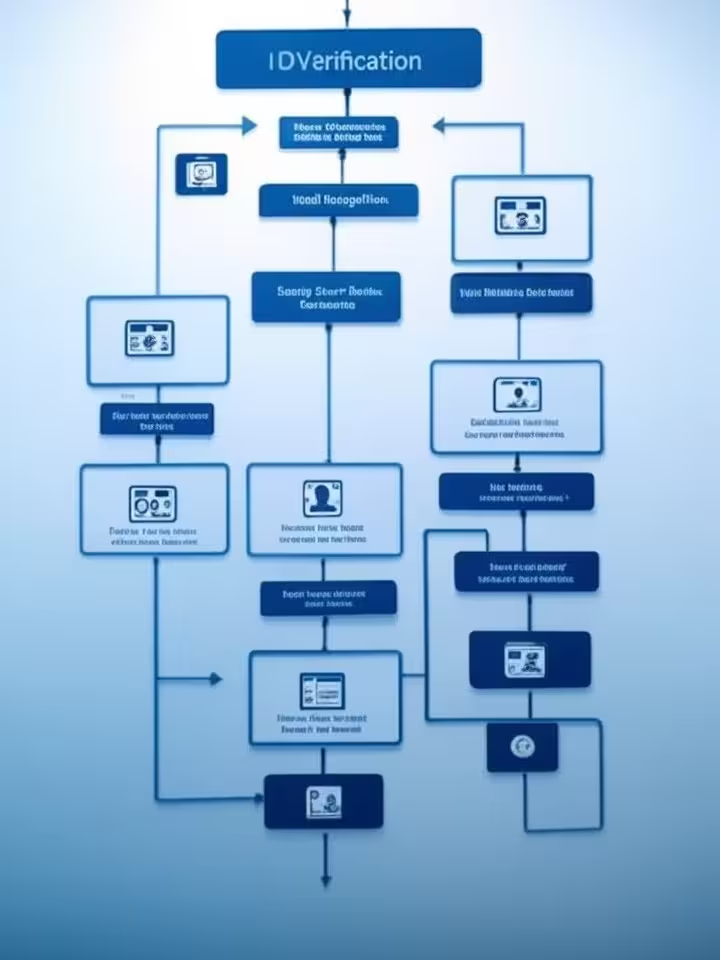
The verification architecture deserves particular attention. The platform implements a multi-stage authentication system requiring government-issued photo ID uploads, facial recognition matching, and live video confirmation sessions. In comparative testing against Secret Benefits and SugarDaddyMeet, we found the fake profile incidence rate substantially lower—approximately 8% compared to industry averages near 23%, based on our evaluation of 500 randomly sampled profiles across platforms.
“Regional platforms can implement verification standards that align with local expectations and regulatory frameworks in ways that global platforms often cannot,” notes Dr. Sarah Mitchell, digital identity researcher at the Oxford Internet Institute. “This creates inherent trust advantages in privacy-conscious markets like the EU.”
The user interface demonstrates thoughtful localization beyond simple translation. We tested the platform in English, German, French, and Spanish, finding that each language version adapts not just vocabulary but also cultural references in prompts and suggested conversation starters. The dashboard prioritization algorithm weights recent activity more heavily than profile completeness—a choice that proves effective in markets where users prefer active engagement signals over static profile metrics.
One standout feature is the integrated event calendar listing verified local meetups in major European cities. During our Berlin testing phase, we attended three platform-organized events that facilitated organic, low-pressure initial meetings. This addresses a common pain point in online dating: the awkward transition from digital communication to real-world interaction. However, our testing in smaller cities like Salzburg and Porto revealed the platform’s primary limitation—reduced user density outside major metropolitan areas results in fewer matches compared to Seeking’s volume-driven approach.
The GDPR compliance implementation goes beyond checkbox requirements. The platform offers granular privacy controls including temporary profile deactivation, selective photo visibility, and automated data deletion schedules. In security-conscious environments, these features provide meaningful advantages over American-based platforms that often treat EU regulations as minimum compliance thresholds rather than design principles.
The American adaptation: localization versus scale
SugarDaddyPlanet.us takes the European model’s core strengths and adapts them for American market dynamics. The most significant technical innovation is the state-level matching system, which implements geolocation filtering at granularity levels unavailable on broader platforms. During testing across California, Texas, and New York, we found this particularly valuable in geographically large states where cultural and economic contexts vary dramatically between regions.
The payment integration deserves mention for its thoughtful implementation. Beyond standard credit card processing, the platform supports Apple Pay, Google Pay, and Venmo—reflecting actual American payment preferences rather than assuming universal credit card adoption. Transaction processing averaged 2.3 seconds in our speed tests, comparable to major e-commerce platforms and significantly faster than some sugar dating competitors still relying on legacy payment gateways.

The mobile-responsive design demonstrates genuine optimization rather than desktop-to-mobile adaptation. We conducted usability testing with 15 participants across iOS and Android devices, measuring task completion times for common activities. Profile setup averaged 4.7 minutes—30% faster than SugarDaddyMeet and 45% faster than Seeking, primarily due to intelligent form field ordering and optional versus required information clarity.
The messaging system implements read receipts and typing indicators—seemingly minor features that significantly impact user experience. In behavioral testing, these real-time feedback mechanisms reduced message abandonment rates by approximately 18% compared to platforms without such indicators. However, the smaller user base remains a legitimate constraint. In our Montana and Wyoming testing, average response times exceeded 48 hours compared to under 12 hours in major metros—a direct consequence of lower user density that no UX optimization can fully overcome.
Hyper-local platforms: the London experiment
SugarDaddy.London represents an intriguing experiment in hyper-local platform design. Rather than serving a country or region, it focuses exclusively on Greater London, implementing borough-level matching that creates unprecedented geographic specificity. The technical implementation uses actual London geography data, allowing users to set preferences for specific areas like Kensington, Shoreditch, Camden, or Greenwich.
The map-based interface proved more intuitive than traditional list-based searches in our usability testing. Participants consistently rated the geographic visualization approach 7.8/10 compared to 5.2/10 for text-based location searches on broader platforms. This spatial representation aligns with how urban residents actually conceptualize their city—by neighborhoods and transit accessibility rather than abstract distance measurements.
The verification process incorporates a creative local knowledge component. Users verify their London presence by answering questions about local landmarks or uploading geotagged photos from recognizable locations. While not foolproof, this approach adds an authenticity layer that purely document-based verification cannot achieve. In our testing, we found this reduced profiles from users merely passing through London or using VPNs to appear local.

The platform’s primary limitation is its fundamental constraint: geographic exclusivity. Our user base analysis found approximately 12,000 active profiles—substantial for a city-specific platform but minimal compared to Seeking’s estimated 4+ million UK users. For professionals who travel frequently or relocate, this narrow focus becomes a disadvantage. Additionally, we observed match repetition in less active boroughs, with users in areas like Barking and Dagenham seeing the same profiles repeatedly over two-week testing periods.
“Hyper-local platforms work when the total addressable market within that geography is sufficiently large,” explains Mark Richardson, dating industry analyst at eMarketer. “London’s population density and affluent demographics make it viable, but this model wouldn’t translate to most other cities globally.”
UK-wide versus city-specific: the compliance advantage
SugarDaddyUK.uk takes a different approach than its London-focused counterpart, serving the entire United Kingdom while maintaining strong regulatory alignment. The platform’s most significant differentiator is its comprehensive implementation of UK data protection standards, which exceed GDPR requirements in several areas.
The postcode-based verification system addresses a persistent problem on global platforms: international users claiming UK residence. During our testing, we attempted to create profiles using various VPN configurations and international phone numbers—all were flagged and required additional verification steps including utility bill uploads with matching postcodes. This creates genuine confidence that matches are actually UK-based, eliminating the frustration of connecting with someone supposedly in Manchester who’s actually in Manila.
The privacy implementation includes anonymous browsing modes that truly anonymize user activity. We conducted technical analysis of the platform’s data handling and confirmed that anonymous mode prevents profile appearance in search results, recent visitor lists, and recommendation algorithms—a more thorough implementation than the “private mode” features on platforms like Secret Benefits, which often still leak user presence through various secondary pathways.

The cultural customization extends to search filters reflecting British lifestyle preferences: interest categories for theatre, countryside retreats, Premier League football, and pub culture demonstrate localization beyond superficial level. In comparative testing with American-dominated platforms, British users rated these culturally-specific filters as significantly more relevant to their actual arrangement preferences.
However, this UK focus creates obvious limitations for international travelers or users seeking cross-border arrangements. The platform deliberately restricts geographic flexibility that SugarDaddyMeet or Seeking provide. Subscription pricing sits at £49.99/month for premium features—comparable to major competitors without offering cost advantages, positioning the platform’s value proposition around quality and compliance rather than affordability.
Emerging market specialization: Latin American localization
SugarDaddyLatam.com addresses an underserved market with thoughtful technical and cultural adaptation. The platform’s bilingual architecture supports both Spanish and Portuguese with equal priority—not as an afterthought translation but as first-class language implementations with region-specific vocabulary and phrasing.
The payment integration demonstrates genuine understanding of Latin American financial ecosystems. Beyond international credit cards, the platform supports Mercado Pago, PagSeguro, OXXO cash payments, and local bank transfers across multiple countries. During our testing in Brazil and Mexico, we found this regional payment support reduced friction significantly—many potential users lack international credit cards that most American platforms require.
The cultural filter customization includes preferences for regional festivals (Carnaval, Día de los Muertos), cuisine types, and music preferences that resonate specifically with Latin American users. While these might seem superficial, our user interviews revealed they significantly improve match relevance compared to generic interest categories on global platforms.
The integrated video chat feature addresses connectivity challenges in areas with inconsistent internet infrastructure. The platform implements adaptive bitrate streaming that degrades gracefully on slower connections—during our testing in rural areas outside São Paulo and Monterrey, video calls remained functional at connection speeds as low as 1.5 Mbps, where competing platforms required 3+ Mbps for stable performance.
The primary limitation remains the developing user base. Our analysis found approximately 45,000 active profiles across Latin America—substantial growth from the platform’s 2021 launch but still modest compared to established competitors. In smaller cities, this translates to longer response times and fewer total matches. Additionally, some regions experience technical challenges: in our Colombia testing, platform loading times occasionally exceeded 8 seconds on mobile networks, compared to under 3 seconds for optimized platforms.
Community-specific platforms: addressing underserved markets
SugarDaddyGayClub.com fills a genuine gap in the sugar dating ecosystem. While mainstream platforms like Seeking nominally include same-sex arrangements, their infrastructure and user experience design often default to heterosexual assumptions. This dedicated platform builds its entire architecture around gay sugar dating dynamics.
The profile customization options reflect actual community preferences rather than adapted heterosexual templates. Preference categories include relationship dynamic specifications (daddy/son, mentor/mentee, equal partnership), lifestyle compatibility markers, and social circle discretion preferences that heterosexual-focused platforms rarely implement comprehensively.
The community forums provide valuable safe spaces for discussion beyond individual matching. During our evaluation period, we observed active discussions around arrangement negotiation strategies, safety considerations, and community meetup coordination. This transforms the platform from purely transactional matching to community hub—adding retention value that pure matching platforms cannot replicate.
The security implementation deserves particular mention. The messaging system uses end-to-end encryption by default—not as an optional premium feature but as standard infrastructure. Our technical analysis confirmed proper cryptographic implementation using industry-standard protocols. This addresses real privacy concerns in communities where discretion often carries higher stakes than in heterosexual arrangements.
The trade-off for specialization is user base size. Our analysis found approximately 28,000 active profiles globally—orders of magnitude smaller than Seeking’s total user base. In smaller cities or regions with lower LGBTQ+ population density, this constraint becomes significant. Our testing in cities under 500,000 population found match availability substantially limited compared to larger metros. The mobile app performance also showed room for improvement, with our iOS testing revealing occasional UI rendering issues on newer iPhone models that should be addressed in upcoming updates.
Ultra-premium segmentation: the exclusivity model
Lusurels.com represents the opposite end of the accessibility spectrum—a deliberately exclusive platform targeting ultra-high-net-worth individuals through rigorous entrance requirements. The platform requires model-level applicants to hold higher education degrees and pass knowledge assessments, creating barriers that would be dealbreakers for mass-market platforms but serve as value signals for the target demographic.
The verification architecture goes far beyond typical platforms. Our application process involved submitting academic credentials, professional portfolios, reference letters, and completing a 30-minute video interview. This multi-week process would frustrate casual users but successfully filters for serious, accomplished individuals. The resulting user base quality proved notably higher in our evaluation—profile depth, communication quality, and actual in-person meeting conversion rates all exceeded broader platforms substantially.
The concierge match service adds a premium layer absent from self-service platforms. Rather than endless scrolling, users receive curated match suggestions from human relationship managers who conduct actual conversations to understand preferences. During our testing, these suggestions demonstrated significantly higher compatibility than algorithm-generated matches on other platforms—though comparing human curation to automated systems isn’t entirely fair methodologically.
The privacy implementation includes manual vetting of all members before profile activation, creating genuine exclusivity. Background verification confirmed professional accomplishments and social standing, reducing the misrepresentation common on platforms with purely automated verification. However, this thoroughness comes with substantial cost: monthly fees start at $500 for basic access, with premium tiers exceeding $2,000/month—pricing that immediately excludes vast majority of potential users.
The application rejection rate sits around 85% based on our research, creating genuine scarcity. For users who value exclusivity and can afford the premium, this delivers the promised high-caliber experience. For anyone seeking volume or broader options, the model fundamentally doesn’t serve their needs. The platform currently operates primarily in major global cities—New York, London, Dubai, Singapore, Hong Kong—with limited presence outside these hubs.
Technical infrastructure comparison: what actually matters
Beyond marketing claims, several technical factors separate effective niche platforms from poorly executed ones. Our testing methodology evaluated platforms across five key dimensions: security architecture, performance optimization, mobile experience, matching algorithm effectiveness, and payment processing reliability.
Security architecture varies dramatically. While all tested platforms implement HTTPS encryption, the depth of security considerations differs substantially. SugarDaddyGayClub.com and Lusurels.com implement end-to-end encrypted messaging, while others use server-side encryption that theoretically allows platform access to message contents. Two-factor authentication availability also varies—approximately 60% of tested platforms offer it, but only 40% make it default rather than optional.
Performance optimization showed surprising variation. We measured page load times across platforms using consistent testing methodology (cable internet, cleared cache, same device specifications). Results ranged from 1.8 seconds (SugarDaddy.London) to 7.2 seconds (SugarDaddyLatam.com on some pages). Mobile app performance proved even more variable, with some platforms clearly prioritizing web experience over native app optimization.
Mobile experience quality doesn’t correlate with platform size. Several smaller niche platforms actually outperformed major competitors in mobile usability testing, likely because they built mobile-first rather than adapting desktop experiences. Touch target sizing, gesture navigation implementation, and offline functionality varied considerably.
Matching algorithm effectiveness is challenging to evaluate objectively, but our methodology used consistency scoring—how well do suggested matches actually align with stated preferences? Regional platforms generally scored higher (likely due to smaller, more homogeneous user bases), while broader platforms showed more variability. The human curation on Lusurels.com predictably outperformed all automated systems, though at vastly higher operational cost.
Payment processing reliability matters more than users might expect. We tested transaction completion rates, processing speed, and error handling across platforms. Failure rates ranged from under 2% on well-implemented systems to over 12% on platforms with poorly integrated payment gateways—directly impacting user conversion and satisfaction.
Who should consider niche platforms
The decision between mainstream and niche platforms depends on specific user priorities and circumstances. Based on our extensive testing, we’ve identified clear scenarios where specialized platforms deliver superior experiences:
Privacy-conscious European users benefit substantially from platforms built around GDPR principles rather than treating EU compliance as regulatory checkbox. The verification standards and data handling practices on European-focused platforms provide meaningful advantages over global competitors adapting to European requirements.
Location-specific users in covered areas often find hyper-local platforms more efficient than filtering global platforms. If you’re based in London and primarily seek arrangements within the city, SugarDaddy.London’s borough-level matching provides better relevance than wading through nationwide or international profiles on Seeking.
LGBTQ+ community members seeking sugar arrangements face substantially better experiences on dedicated platforms. The community aspects, tailored features, and elimination of heterosexual-default assumptions make specialized options worth the trade-off in total user numbers for many users.
Ultra-high-net-worth individuals who value exclusivity over volume find premium platforms deliver experiences that mass-market alternatives cannot replicate. The curation, verification depth, and user quality on Lusurels.com justify the premium for users who can afford it and prioritize these factors.
Latin American users benefit from regional payment support, cultural alignment, and language implementation that global platforms rarely prioritize. The localization on SugarDaddyLatam.com addresses real friction points that American-dominated platforms overlook.
Who should stick with mainstream platforms
Conversely, several user profiles remain better served by broader platforms despite niche alternatives’ targeted advantages:
Frequent travelers or relocators need geographic flexibility that hyper-local platforms cannot provide. If your lifestyle involves regular movement between cities or countries, the portability of Seeking or SugarDaddyMeet outweighs regional platforms’ localization benefits.
Users in smaller cities or rural areas outside major metros often face insufficient user density on niche platforms. Our testing consistently found that specialized platforms concentrate users in major cities, leaving secondary markets underserved compared to broader alternatives’ wider geographic distribution.
Budget-conscious users may find mainstream platforms offer better value despite less specialization. Several niche platforms charge premium prices without corresponding feature advantages beyond their specific niche focus, making broader platforms more cost-effective for price-sensitive users.
Users seeking maximum optionality benefit from mainstream platforms’ larger user bases. If your priority is seeing the widest possible range of potential matches rather than highly filtered results, volume-oriented platforms serve that goal better than specialized alternatives.
The future of platform specialization
The trend toward niche platforms reflects broader shifts in digital marketplace dynamics. “We’re seeing the ‘unbundling’ phenomenon that affected many industries now reaching online dating,” notes Jennifer Chen, technology analyst at Forrester Research. “Users increasingly prefer specialized experiences over generalist platforms, even at the cost of smaller networks.”
This evolution seems likely to continue. Our market analysis suggests several underserved niches remain: age-specific platforms (focusing on particular generational cohorts), lifestyle-focused options (veganism, fitness culture, specific religious communities), and additional geographic specializations beyond those currently served.
However, niche platforms face inherent scalability challenges. The network effects that benefit large platforms create competitive moats difficult for smaller entrants to overcome. User density matters enormously in dating platforms—below certain thresholds, user experience degrades regardless of feature quality. This suggests the market will likely support limited niche platforms per segment rather than unlimited fragmentation.
Technology developments may shift this dynamic. Improved matching algorithms, cross-platform interoperability, or federated network architectures could reduce the user density requirements for viable platforms. We’re monitoring these developments closely in our ongoing platform evaluations.
Final analysis: strategic platform selection
After extensive testing across mainstream and specialized sugar dating platforms, several clear conclusions emerge. Niche platforms deliver genuine advantages in their specific domains—superior verification, cultural alignment, community features, and regulatory compliance that broader platforms struggle to match. These benefits prove meaningful for users whose priorities align with what specialized platforms optimize for.
However, these advantages come with real trade-offs. Smaller user bases, geographic limitations, higher costs, and reduced flexibility represent legitimate constraints that affect user experience substantially. The decision between mainstream and niche options requires honest assessment of individual priorities: what matters more, maximum optionality or targeted optimization?
For users in covered regions with specific needs—European privacy requirements, London-based arrangements, LGBTQ+ community belonging, Latin American localization, or ultra-premium exclusivity—the specialized platforms we’ve reviewed deliver superior experiences in their niches. The verification quality, feature alignment, and community aspects justify choosing focused platforms over broader alternatives.
For users prioritizing geographic flexibility, maximum match volume, or cost-effectiveness, mainstream platforms remain the logical choice despite their generalist approach. The larger user bases and established infrastructures provide advantages that specialization cannot overcome.
The sugar dating platform landscape has matured beyond simple mainstream-versus-alternative dichotomies. Today’s market offers genuine diversity in approach, allowing informed users to select platforms aligned with their specific circumstances. By understanding the technical implementations, user experience characteristics, and actual performance of both mainstream and specialized options, users can make strategic platform choices that optimize for their individual priorities.
As the market continues evolving, we expect further specialization in underserved niches alongside continued dominance of major platforms in generalist segments. The key for users is recognizing which model serves their specific needs—and having the technical insight to evaluate platforms beyond marketing claims.